


Blepharoplasty in Cincinnati
(Eyelid Surgery)- An emphasis on preserving and reorienting eyelid fat rather than removing all fat, which can potentially create a hollowed-out appearance.
- A lateral temporal brow lift can complement an upper blepharoplasty well.
- A deep plane facelift can complement a lower blepharoplasty well.
- Upper blepharoplasty can be performed under local anesthesia.
Contact Us

What is a Blepharoplasty?
Blepharoplasty is a surgical procedure which can be performed on the upper eyelids or the lower eyelids. An upper eyelid blepharoplasty involves excising a complex curvilinear shape of excess skin on the upper eyelid such that the eventual incision falls in a natural crease. Additional interventions include shrinking or reorienting fat pads in the upper eyelids and securing drooping tissue to the bony rim of the eye. A lower blepharoplasty involves an incision on the inner lining of the lower eyelid where bulging fat pads are accessed and reoriented down towards the cheeks to better blend in with cheek fat. Additional interventions include the excision of excess lower eyelid skin along a line hidden under the eyelashes, the placement of support sutures to strengthen the lower eyelid and reinforce a more youthful shape, and the lifting and tightening of loose muscle, all through the incision under the eyelashes.
What Conditions Does Blepharoplasty Surgery in Ohio Address?
A blepharoplasty helps address age related changes to the upper and lower eyelids. It helps conditions that not only make patients look older but also can make them look tired and sad. Conditions that a blepharoplasty help address include:

Before & After
Explore our galleries to see the stunning, natural results delivered by one of the best blepharoplasty surgeons in Cincinnati, Dr. Harmon.
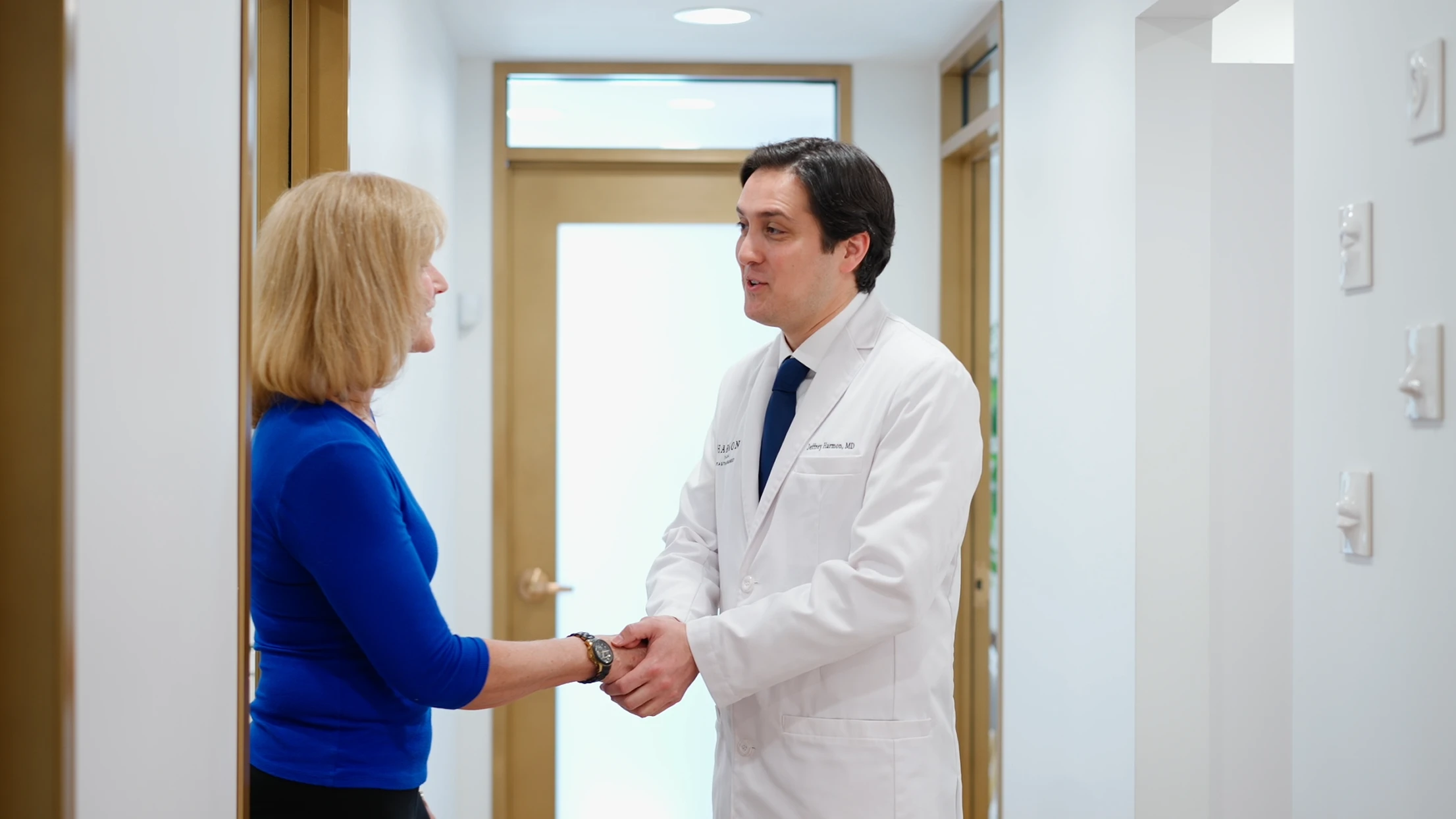


Why Choose Dr. Harmon for Blepharoplasty in Cincinnati?
The desire for youthfulness is understandable. There is no area more important than the face. After all, the face cannot be hidden. It is how we present ourselves to the world. Dr. Harmon works with a refined eye and trained hands to develop a personalized treatment plan with you, utilizing advanced techniques in surgical and non-surgical care of the face, nose, eyes, neck and hair.
Fellowship trained facial plastic surgeons have a unique specialized skill set in performing surgical and non-surgical procedures on the face, nose, eyes, neck and hair. The pathway to becoming a facial plastic surgeon begins with five years of rigorous training in head and neck surgery. This training is focused on all aspects of surgery for the head and neck, in addition to aesthetic and reconstructive procedures.
A small pool of top performing graduates from head and neck surgery programs are then selected to complete sub-specialty training as a fellow in facial plastic and reconstructive surgery through the American Academy of Facial Plastic and Reconstructive Surgery (AAFPRS).
Dr. Harmon completed his fellowship in facial plastic surgery through the AAFPRS with the world-renowned facial plastic surgeon Dr. Andrew Jacono on Park Avenue in New York City. Dr. Jacono is world renowned for developing the extended deep plane facelift technique. Dr. Harmon is one of the few surgeons in the world, and the only surgeon in the Cincinnati area, fellowship trained in this technique by Dr. Jacono.
QUAD A ACCREDITED SURGERY SUITE

Harmon Facial Plastic Surgery is proud to have a Quad A accredited operating room and facility in our office. Our single-physician, single-specialty facility meets or exceeds the strict guidelines and high standards set forth by Quad A, demonstrating our strong commitment to patient safety and excellence in surgical care. We utilize the services of board-certified anesthesiology physicians only as well as our own personal clinical support staff to ensure the most comfortable, safest experience for our clients.
Out-of-Town Patients
This level of care draws patients from across the Tri-State region, including Cincinnati, Ohio, Northern Kentucky, Indiana, and surrounding communities. Our team coordinates every consultation, procedure, and follow-up appointment for those traveling from outside the local area, so the distance is the only hard part.

Types of Blepharoplasty Procedures
There are two types of blepharoplasty procedures, an upper blepharoplasty procedure and a lower blepharoplasty procedure. Each procedure helps address age-related changes to their respective anatomic location. The procedures can be performed together, if indicated.
Lower Blepharoplasty
A lower blepharoplasty procedure reorients a significant portion of the lower eyelid fat protruding out and away from the cheek, down, towards the cheek. Called fat transposition/preservation lower blepharoplasty, this approach preserves most of the fat in the lower eyelids. The procedure can help smooth out and, therefore, imbue the appearance of a more youthful transition of volume from the lower eyelid to the cheeks using fat with a stable blood supply near its natural location (1, 2). Additional volume can be added, as needed, to the junction between the lower eyelid and cheeks using the patient’s own fat from their abdomen, flanks, and/or inner thighs. A sliver of excess skin can be pinched from a natural crease immediately below the eyelashes for those individuals with excess, redundant skin at this location. It is through this skin pinch incision that loose, blousy lower eyelid muscle and a droopy, rounded lower eyelid margin can be improved using stitches/sutures.
An essential concept to understand about blepharoplasty surgery, especially lower blepharoplasty surgery, is the importance of balancing adding, removing, and/or repositioning volume i.e. fat in this location (3, 4). After all, one major reason for an aged appearance of the lower eyelids is the bulging malposition (pseudoherniation) of fat. Historically, there was an emphasis on removing/excising as much of the pseudoherniated fat i.e. eyelid bags in the lower eyelids as possible. Unfortunately, Dr. Harmon has observed that this approach can leave patients hollow and even looking older, especially if they lose volume in the superficial compartments of their face with age. Eventually, surgeons began to understand the importance of volume and a smooth transition from the lower eyelids to the cheeks. As a result, fat grafting was performed at the cheeks near their junction with the lower eyelids. A potential problem with removing most fat from the lower eyelids and adding more to this location is that the lower eyelids can still look hollow – especially with time – and fat transferred from other parts of the body is not a perfect match with the fat native to the area (5). It is for the above reasons that Dr. Harmon’s surgical philosophy for lower blepharoplasty is to:
- Preserve and reorient as much of the native volume as possible.
- Utilize conservative fat grafting only if needed and only as a supplement to the preserved, reoriented fat.
While a more complex procedure, Dr. Harmon is fellowship-trained and experienced in fat transposition/preservation lower blepharoplasty. He feels that this approach can provide natural-appearing results and better preserve a more youthful, refreshed appearance over time. He believes a balanced surgical philosophy that is tailored to the individual involves preserving and enhancing their natural volume.
Upper Blepharoplasty
Some patients demonstrate droopy, pseudo herniated fat pads near their nose. The size of these fat pads is reduced through the incision created by skin removal. Some patients have poor definition of the bony rim around their upper eyelids laterally. Some of these patients may be a candidate for a technique that tucks some of this tissue closer to the bony margin of the upper eyelid. The broad goals of an upper blepharoplasty procedure are to improve the contours of the upper eyelids within anatomic limitations.
Overview of the Procedure
The team at Harmon Facial Plastic Surgery works tirelessly to prepare patients well for surgery. The time spent with patients and resources provided facilitates a smooth transition from surgery through recovery. The following overview is a broad summary of the information provided to patients:
Procedure Consultation
Expect a detailed, informative discussion with Dr. Harmon about your concerns and aesthetic goals. He will develop a personalized treatment plan to address these concerns and goals.
Pre-Treatment Preparation
Patients receive a packet with detailed pre-operative instructions prior to surgery. This packet includes information on what supplements and medications to hold prior to surgery, activity restrictions, and what supplies are necessary for post-operative recovery. Prescriptions are sent prior to surgery with instructions on their use. Finally, if medical clearance is required, a form detailing the necessary clearance and testing is provided to present to their primary care provider.
Day of Treatment
Patients are instructed to arrive at the office in comfortable clothes. The surgical plan is discussed with the patient in detail. Paperwork is completed. Photos are usually taken pre-operatively. Finally, the patient meets the surgical team, which may include nurses, anesthesiologists, and/or scrub technologists, depending on the procedure(s) and type of anesthesia used.
Follow-Up Appointment
Patients are instructed to apply cold compresses to the eyes for the first forty-eight (48) hours after surgery. Patients typically follow up for suture removal on day five (5) after surgery. Patients who undergo lower blepharoplasty are usually seen every two (2) weeks for the first six (6) weeks after surgery to monitor healing.
Social Readiness
Patients are generally permitted to wear makeup on the surgical site after all sutures are removed. The time to resolution of bruising and swelling varies and depends on multiple patient-specific factors. The incision can take months to heal completely, though they are tucked in natural creases and folds in the skin. However, many feel ready to socialize approximately seven (7) to fourteen (14) days after surgery.
Ideal Candidates for Eyelid Surgery in Ohio
The ideal candidates for blepharoplasty include those patients who demonstrate:
- Excess lower eyelid skin
- Excess upper eyelid skin
- Upper eyelid bags
- Lower eyelid bags
- Loose or blousy lower eyelid muscle
- Droopy, rounded lower eyelid margin
Most candidates for blepharoplasty range in age from thirties (30s) to seventies (70s). A consultation is essential to determine candidacy for the procedure, because there may be factors that preclude this procedure for certain individuals. Reasonable expectations must be established about what eyelid surgery can and cannot accomplish as with all plastic surgery procedures. As with all facial plastic surgery procedures, results can vary.
What to Expect from Recovery
Recovery from eyelid surgery is specific to the individual. The duration of recovery will vary from person to person.
The initial recovery time for an upper blepharoplasty is approximately seven (7) to ten (10) days for most individuals. The initial recovery time for a lower blepharoplasty is approximately ten (10) to fourteen (14) days in most individuals but could be longer depending on the surgical approach.
No dressings are required after surgery. Sutures are removed approximately five (5) days after surgery, after which makeup can generally be applied to the eyelid skin. Incisions continue to heal for months after surgery.
Some swelling and bruising are expected after eyelid surgery. Post-operative swelling and bruising generally improve significantly by seven (7) to fourteen (14) days after surgery. Swelling and bruising are expected to continue to improve and resolve in the ensuing days and weeks.
Sutures are removed
Initial recovery time for an upper blepharoplasty
Swelling and bruising are improved
Initial recovery time for a lower blepharoplasty
Benefits of Blepharoplasty
Blepharoplasty helps address many features of age-related changes to the upper and/or lower eyelids (2). It can help:
- Improve a sensation of heaviness in the upper eyelids
- Increase the visibility of the upper eyelids in an anatomically appropriate manner
- Tighten the border between the upper eyelids and eyebrows to the extent possible
- Reduce bags in the lower eyelids
- Create a more youthful transition between the lower eyelids and cheeks
- Create a more almond-shaped eye
Risks of Blepharoplasty
The potential risks of blepharoplasty include, but are not limited to:
- Bruising
- Swelling
- Infection
- Abnormal scarring
- Damage to the eyes
- Difficulty closing the eyes
Combine Blepharoplasty with Other Facial Enhancements
The blepharoplasty procedure complements other surgical and non-surgical procedures well. It complements other surgical procedures that lift drooping tissue by further emphasizing an elevation of the focal areas of facial aesthetics. It complements non-surgical procedures by helping to address age-related changes that develop concurrently but that non-surgical procedures do not. In addition, an upper blepharoplasty procedure can be performed with a lower blepharoplasty procedure, as indicated, to more comprehensively address eye aesthetics. Procedures that complement a blepharoplasty procedure include, but are not limited to:
Deep plane facelift
A deep plane facelift can lift cheek volume towards the lower eyelid, thereby improving the contour at the interface between the lower eyelid and the cheek.
Facial fat grafting
Facial fat grafting, specifically nanofat grafting, helps address skin surface changes that a blepharoplasty procedure cannot.
Brow lift
A brow lift lifts the lateral eyebrow up and back can help create a more defined contour to the lateral bony rim of the eye and reduce the amount of skin necessary to remove during an upper blepharoplasty procedure.
Laser skin resurfacing
Laser skin resurfacing helps address skin surface changes that a blepharoplasty procedure cannot.
Fillers
Fillers can restore subtle volume to areas like the tear troughs or cheeks when combined with a blepharoplasty procedure.
Book Your Consultation
Take the first step toward your aesthetic goals with a personalized consultation. Dr. Harmon will listen to your concerns, answer your questions, and guide you through your options. Serving Dayton, Columbus, and all of Ohio, schedule your consultation today and discover how expert care can make a difference.
Read More about Blepharoplasty
How to Treat Drooping, Hooded Eyes That Can Make Us Look Tired
Our experience at Harmon Facial Plastic Surgery has been that most people do not present to our clinic specifically requesting a brow lift, let alone requesting to "lift of my entire eyebrow x inches." Instead, most present feeling like their eyes look less open and are unsure why. They may pinch the skin on their upper eyelids, describing difficulty with applying makeup because it gets "caught under the folds of skin up there." They often also pull up the side of their brows, explaining how this makes them feel more youthful, that more sunlight reaches their eyes this way. Broadly, these individuals seek an intervention that can open their eyes back up, highlighting their beautiful shape and color. Surgery is usually the best way to achieve this. It is important to consider both the eyebrows and the upper eyelids when developing a surgical plan because, while treatment of the eyebrows or the eyelids may be effective by themselves, treating both areas together is often the most effective and natural appearing. It is important to seek not only a fellowship-trained but also a double board-certified facial plastic surgeon if you have aesthetic concerns about your face and/or neck. Excessive Upper Eyelid Skin Removal with Surgery Can Make a Brow Lift Impossible Dr. Harmon has consulted with and treated multiple patients who have undergone upper eyelid (blepharoplasty) surgery elsewhere and now seek treatment of their drooping eyebrows. Too often, these individuals have presented with excessive skin and fat removal in the eyes. The telltale signs of this can include: A wide scar which is usually placed too close to the eyelash margin and away from the natural upper eyelid crease. Excessive show of the upper portion of the eyeball, called excess tarsal show. Difficulty closing the eyes, called lagophthalmos, which is not always apparent when awake but can be apparent when asleep. These individuals may not be able to undergo a brow lift because their eyes do not close completely if the brow is lifted. These examples demonstrate the connection between the eyebrow and upper eyelid. It is why Dr. Harmon always considers both areas when assessing the most appropriate treatment for age-related changes around the eyes. The Lateral Temporal Brow Lift Can Restore Some of the Youthful Eye "Glow" The lateral temporal brow lift is a surgical procedure that can address the most common feature of aging in the eyebrow, the drooping of its most lateral portion. Drooping can lead to hooding over the upper eyelid where the volume of the brow hangs over the lateral edge of the eye, making the eyes look less open. This procedure is performed with only two small incisions within the hair. And, while this may be the only procedure necessary to achieve the desired results, the upper eyelid itself also needs to be evaluated. Upper Eyelid (Blepharoplasty) Surgery Can Also Restore Some of the Youthful Eye "Glow" Upper eyelid (blepharoplasty) surgery is focused on excess folds of skin that can develop on the upper eyelid itself but extend to the interface with the drooping brow tissue. Importantly, every eyelid is different, even on the same individual. As a result, while the basic shape of the excision remains the same, there are and should be slight differences in how the skin is excised because of those often-subtle differences in the skin. Dr. Harmon also lifts the lateral brows when designing the upper eyelid surgery to preserve the ability to address the eyebrows in the future if that need/desire arises. The Lateral Temporal Brow Lift and Upper Eyelid (Blepharoplasty) Can Be Complementary The lateral temporal brow lift and upper eyelid (blepharoplasty) surgery can complement each other because these anatomical sites interact and blend in with each other. As a result, one cannot consider one procedure without considering the other. This philosophy carries through to other areas as well, for example, in the way the extended deep plane facelift complements the neck lift more completely than other facelift procedures. The following two patients are examples of the power of the combination of the procedures to "open up" the eyes in a natural appearing way. Trust Your Face to a Facial Plastic Surgeon It is important to seek a fellowship-trained specialist in plastic surgery of the face and neck when you have concerns about your face or neck. Why Choose Dr. Harmon The mission of Harmon Facial Plastic Surgery is to help people along their journey towards self-confidence, to feel good about feeling good. Dr. Harmon is a double board-certified facial plastic surgeon Dr. Harmon values making patients feel welcomed, listened to, and respected. Dr. Harmon graduated with honors from Cornell University with a Bachelor of Science degree in molecular biology. Dr. Harmon earned his medical degree from the University of Cincinnati. Dr. Harmon underwent five years of extensive training in head at neck surgery at the prestigious residency program at the University of Cincinnati. Dr. Harmon then underwent focused fellowship training in cosmetic facial plastic surgery through the American Academy of Facial Plastic and Reconstructive Surgery (AAFPRS) with the world-renowned surgeon, Dr. Andrew Jacono, on Park Avenue in New York City. Request a Consultation Request a consultation with Dr. Harmon at Harmon Facial Plastic Surgery in Cincinnati. Visit our clinic. You will learn more about Dr. Harmon's credentials, style, and approach. Build a relationship with our dedicated team. Do not stop searching "plastic surgery near me." Get in touch with us to learn more. Contact Us

The “Fox Eye” Procedure: What is It and is it Worthwhile?
The "Fox Eye" procedure has become a trending topic on social media, including TikTok. The procedure stretches the side of the eyebrow and temple skin. It most likely involves the use of barbed stitches/sutures in a manner like threading in the face and neck. Everyone is entitled to their own conception of what is beautiful. However, the significant limits of the use of threading and the resultant significant distortion of the anatomy it causes make the procedure not worthwhile in the opinion of Dr. Harmon. This procedure is sometimes confused with the lateral temporal brow lift surgical procedure. In contrast with the "Fox Eye" procedure, this surgical procedure can provide a long-lasting and natural-appearing lift of drooping lateral eyebrows and smoothing of the temple tissue in the appropriate candidate. This blog post seeks to explain the problems with the "Fox Eye" procedure and to contrast it with the lateral temporal brow lift. It is important to seek not only a fellowship-trained but also a double board-certified facial plastic surgeon if you have aesthetic concerns about your face and/or neck. The "Fox Eye" Procedure Significantly Distorts the Facial Anatomy in an Unnatural-Appearing Way The "Fox Eye" look appears exaggerated and pulled. The area stretched to the side and up includes the most lateral portion of the eyebrow and the temple skin. The procedure does not appear to result in facial anatomy that approximates the range of what humans normally demonstrate. A similar effect can occur with older, less effective facelift techniques that can result in a distorted mouth and "windswept" appearance. This effect runs counter to the philosophy of Dr. Harmon, who strongly feels that directly addressing as many of the underlying causes of age-related changes to the face is the best way for natural appearing results. The "Fox Eye" Procedure is Likely Performed Using Dissolvable Barbed Stitches Threading, which involves the use of dissolvable barbed stitches/sutures inserted into the skin in multiple locations, is likely the most common method used to achieve a "fox eye" look. Dr. Harmon does not endorse the use of threading anywhere in the face. First, the stitch/suture is simply a commonly used dissolvable suture but with barbs on it. The effect is temporary because the suture is dissolvable, typically lasting only a few months. Second, the sutures are placed blindly into tissue planes, making appropriate placement difficult. Third, there is no surgical separation of the volume that needs to be lifted from the deeper structures of the face or the release of this tissue from tension points in the face that would be necessary to prevent distortion of the facial anatomy. The Lateral Temporal Brow Lift is a Surgical Procedure that Can Provide a Natural Appearing Lift of the Lateral Brow and Temple The lateral temporal brow lift contrasts with the "Fox Eye" procedure because it is a surgical procedure that involves the dissection of volume off the deeper structures of the face, including the release of tension points along the eyebrow. The result is the lifting of the lateral brow and smoothing of the temple volume in a long-lasting manner without distorting the surrounding anatomy. And while dissolvable stitches/sutures are used to suspend the tissue, this is only temporary until the lifting tissue has had time to heal against the deeper tissue again. As with all procedures, however, a consultation with a qualified surgeon is essential to determine whether an individual is a candidate for the lateral temporal brow lift. Trust Your Face to a Facial Plastic Surgeon It is important to seek a fellowship-trained specialist in plastic surgery of the face and neck when you have concerns about your face or neck. Why Choose Dr. Harmon The mission of Harmon Facial Plastic Surgery is to help people along their journey towards self-confidence, to feel good about feeling good. Dr. Harmon is a double board-certified facial plastic surgeon Dr. Harmon values making patients feel welcomed, listened to, and respected. Dr. Harmon graduated with honors from Cornell University with a Bachelor of Science degree in molecular biology. Dr. Harmon earned his medical degree from the University of Cincinnati. Dr. Harmon underwent five years of extensive training in head at neck surgery at the prestigious residency program at the University of Cincinnati. Dr. Harmon then underwent focused fellowship training in cosmetic facial plastic surgery through the American Academy of Facial Plastic and Reconstructive Surgery (AAFPRS) with the world-renowned surgeon, Dr. Andrew Jacono, on Park Avenue in New York City. Request a Consultation Request a consultation with Dr. Harmon at Harmon Facial Plastic Surgery in Cincinnati. Visit our clinic. You will learn more about Dr. Harmon's credentials, style, and approach. Build a relationship with our dedicated team. Do not stop searching "plastic surgery near me." Get in touch with us to learn more. Contact Us
Lower Eyelid Botox® i.e., “Jelly Roll” Botox: Is it Safe and Effective?
The treatment of the lower eyelid with Botox® or similar medications has become a trending topic on social media, including TikTok. Commonly referred to as "jelly roll" Botox®, this Food and Drug Administration (FDA) off-label treatment has aesthetic goals. But does its apparent increasing popularity mean it is a safe and effective treatment? See a similar discussion on the placement of Botox® or similar medications in a neck and back muscle called the trapezius. It is important to seek not only a fellowship-trained but also a double board-certified facial plastic surgeon if you have aesthetic concerns about your face and/or neck. "Jelly Roll" Botox Targets the Lower Eyelid This treatment targets the lower eyelid with Botox® or similar medications. The target muscle is the orbicularis oculi, which is a muscle that wraps around the eye and is composed of multiple parts delineated by how close the muscle fibers are to the upper and lower eyelid margins. The most lateral portion of the orbicularis oculi is targeted by Botox® or similar medications when the crow's feet are treated. In contrast, "jelly roll" Botox® targets the muscle at the lower eyelid near the margin of the lower eyelid. The Purpose of the Procedure is to Treat Bunching of the Lower Eyelid The purpose of this procedure is to reduce bunching of the orbicularis oculi muscle that can be exaggerated in certain individuals who demonstrate hyperactive muscle movement in the lower eyelid. This can be bothersome to some patients, especially when they smile. It can appear as if the muscle and skin are folded on themselves like an accordion and protruding beyond the eyelashes. Placement of Botox® or Similar Medications in the Orbicularis Oculi at the Lower Eyelid Has Important Safety Considerations There are important safety considerations with placement of Botox® or similar medications in the lower eyelid. First, the treatment is FDA off-label. As a result, its safety and effectiveness has not yet been official established by the United States (US) government. Second, the orbicularis oculi muscle has an important function in the lower eyelid in that its function is essential to maintain lower eyelid shape and in eye closure. Weakening of the muscle in this location can make the lower eyelid look saggy and overly rounded. It can also limit eye closure, which can lead to or exacerbate dry eye symptoms. Persistently dry eyes can then lead to vision problems. The above risks may not make treatment of this location Botox® or similar medications worthwhile at this time. Trust Your Face to a Facial Plastic Surgeon It is important to seek a fellowship-trained specialist in plastic surgery of the face and neck when you have concerns about your face or neck. Why Choose Dr. Harmon The mission of Harmon Facial Plastic Surgery is to help people along their journey towards self-confidence, to feel good about feeling good. Dr. Harmon is a double board-certified facial plastic surgeon Dr. Harmon values making patients feel welcomed, listened to, and respected. Dr. Harmon graduated with honors from Cornell University with a Bachelor of Science degree in molecular biology. Dr. Harmon earned his medical degree from the University of Cincinnati. Dr. Harmon underwent five years of extensive training in head at neck surgery at the prestigious residency program at the University of Cincinnati. Dr. Harmon then underwent focused fellowship training in cosmetic facial plastic surgery through the American Academy of Facial Plastic and Reconstructive Surgery (AAFPRS) with the world-renowned surgeon, Dr. Andrew Jacono, on Park Avenue in New York City. Request a Consultation Request a consultation with Dr. Harmon at Harmon Facial Plastic Surgery in Cincinnati. Visit our clinic. You will learn more about Dr. Harmon's credentials, style, and approach. Build a relationship with our dedicated team. Do not stop searching "plastic surgery near me." Get in touch with us to learn more. Contact Us
FAQ
What type of anesthesia is required?
Upper eyelid (blepharoplasty) surgery can be performed under local anesthesia or IV sedation. Lower eyelid (blepharoplasty) surgery can usually be performed under IV sedation. Some individuals may require general anesthesia for lower eyelid (blepharoplasty) surgery.
Is eyelid surgery (blepharoplasty) painful?
Facial plastic surgery procedures are generally well-tolerated by patients and typically involve little pain, especially when compared with surgery on other areas of the body. Patients are usually prescribed just a small amount of pain medication for after surgery. In fact, we have found most use only over-the-counter pain medication including acetaminophen and/or ibuprofen after surgery instead. And those who do use the prescribed pain medication usually only use it the first night after surgery. With that in mind, it is important to note that every patient perceives and processes pain differently. Some patients have a high pain tolerance. Others may be more predisposed to be more sensitive to pain. We at Harmon Facial Plastic Surgery are focused on balancing minimizing post-operative discomfort and maximizing safety.
Can lower eyelid surgery (blepharoplasty) treat dark circles under the eyes?
No. There is no procedure, surgical or non-surgical, or medication, topical or oral, that has been shown to treat dark circles under the eyes.
What is the difference between a brow lift (lateral temporal brow lift) and upper eyelid surgery (blepharoplasty)?
Many individuals’ concerns about their upper eyelid may include their brow. Many individual’s concerns about their eyebrow may include their upper eyelid. Therefore, a brow lift (lateral temporal lift) and upper eyelid surgery (blepharoplasty) are frequently performed together, because they complement each other in the rejuvenation of the eye.
Is eyelid surgery a common surgical procedure?
Yes, eyelid surgery is a common surgical procedure. The International Society of Aesthetic Plastic Surgery (ISAPS) releases statistics each year that provide insight into the state of plastic surgery around the world. ISAPS reported 114,030 eyelid surgeries were performed in the United States in 2024.
Does lower eyelid surgery (blepharoplasty) treat festoons or malar mounds/bags?
Festoons and malar mounds/bags are swollen areas of the cheek below the lower eyelid that can occur with aging. Lower eyelid surgery (blepharoplasty) does not treat festoons or malar mounds/bags.
Can eyelid surgery change the shape of the eyes?
Some individuals develop pulled, overly-rounded lower eyelids after lower eyelid (blepharoplasty) surgery due to excessive scarring. Revision lower eyelid surgery can restore an almond-shaped appearance to the eyes by supporting the lower eyelid \"hammock\" through a procedure called a canthopexy or canthoplasty.
What is a lower eyelid skin pinch and is it worthwhile?
A lower eyelid skin pinch procedure is intended to address excessive, wrinkled skin at the lower eyelid. It is often beneficial as a standalone procedure in younger patients who do not demonstrate other age-related changes to their eyes including, but not limited to, lower eyelid bags.
Does eyelid (blepharoplasty) surgery leave bad scars?
No. Upper eyelid surgery and lower eyelid surgery almost always leaves subtle, well-hidden incisions. The upper eyelid incision is nestled within a natural crease. The lower eyelid incision is tucked immediately below the eyelash line without removing eyelashes. Check out the gallery for some examples of post-operative upper and lower eyelid incisions.
Will my eyes look "hollow" after eyelid surgery (blepharoplasty)?
Dr. Harmon avoids the hollowed appearance that can occur with older techniques to eyelid surgery. Dr. Harmon preserves the eye muscle in the upper eyelid and removes only a small amount of fat in a targeted area of the eye, preserving the youthful volume of the upper eyelid. Dr. Harmon utilizes the eye's own fat in the lower eyelid, transferring it into the deep fold under the eyelid bag, called the tear trough deformity, both to treat the eyelid bag and to volumize the tear trough.
Written by Dr. Harmon
Discover the expertise and compassionate care of Dr. Jeff Harmon, a fellowship-trained facial plastic surgeon deeply rooted in the Cincinnati community. A former collegiate athlete and Cornell University graduate, Dr. Harmon brings discipline, precision, and a global perspective to his surgical practice—refined through elite fellowship training in New York City.
Located in Hyde Park, Harmon Facial Plastic Surgery proudly serves patients throughout the Cincinnati area offering personalized facial aesthetics with world-class skill and a hometown heart.
References
- Weng C, Quatela V. Achieving a Youthful Midface: Examination of Midface Anatomy Improvement Following Lower Blepharoplasty With Fat Transposition and Transtemporal Midface Lift With Lower Lid Skin Pinch. Aesthet Surg J. 2019 Sep 13;39(10):NP416-NP428.
- Massry GG. Commentary on: Achieving a Youthful Midface: Examination of Midface Anatomy Improvement Following Lower Blepharoplasty With Fat Transposition and Transtemporal Midface Lift With Lower Lid Skin Pinch. Aesthet Surg J. 2019 Sep 13;39(10):NP429-NP430.
- Massry GG, Azizzadeh B. Periorbital fat grafting. Facial Plast Surg. 2013 Feb;29(1):46-57.
- Wang Y, Massry GG. Aesthetic Blepharoplasty. Facial Plast Surg Clin North Am. 2026 Feb;34(1):103-118. doi: 10.1016/j.fsc.2025.08.004. Epub 2025 Oct 17.
- Maamari RN, Massry GG, Holds JB. Complications Associated with Fat Grafting to the Lower Eyelid. Facial Plast Surg Clin North Am. 2019 Nov;27(4):435-441. doi: 10.1016/j.fsc.2019.07.001. Epub 2019 Aug 30.